
Burgundy is one of the world's most prestigious wine regions, and one of the most difficult to navigate without dedicated transport. Between Dijon and Mâcon, the UNESCO World Heritage-listed vineyards stretch along a hundred kilometers of narrow roads, lined with villages whose names appear on the most prestigious wine maps: Gevrey-Chambertin, Vosne-Romanée, Nuits-Saint-Georges, Meursault, Puligny-Montrachet. For an international group, attempting to connect these destinations by train or private vehicles means losing most of their available time to logistics.
A private coach with a driver completely changes the equation. The group stays together from departure to arrival, luggage travels with them, wine tastings can be enjoyed without the constraints of driving, and the itinerary adapts to the actual rhythm of the day rather than to connecting schedules. This guide details how to structure a Burgundy vineyard tour for a group coming from abroad, which stops to prioritize, and what logistical points to anticipate before booking.
Why Burgundy is best visited by private coach
The Burgundy wine region is extremely fragmented. One estate might cultivate just a few rows of vines in a single plot, while the next could be several kilometers away. Cellar visits are by appointment only, often in villages of a few hundred inhabitants where public transport is minimal, or even nonexistent on weekends. A group wishing to visit two or three estates in a single day therefore needs a vehicle waiting for them, parking nearby, and leaving when the visit is over.
The question of wine tasting is just as crucial. A day in the vineyards inevitably involves tasting wines: entrusting the driving to a professional chauffeur is not merely a matter of comfort, but a requirement for safety and compliance with French regulations. This is precisely what the... coach hire with driver, where the vehicle and its driver remain at the disposal of the group for the entire duration of the program.
The concrete advantages for a foreign organizer are as follows:
- A single meeting point, even if the group arrives from Paris, Lyon or an airport.
- An itinerary that can be modified during the day if a visit is prolonged or if the weather requires an adjustment.
- Luggage and bottle purchases transported in the hold, without handling between each stage.
- A driver who knows the access routes, permitted parking areas and traffic restrictions of the wine villages.
- A cost per person that is generally more predictable than the sum of several car rentals and train journeys.
The essential stops on the Route des Grands Crus
The Route des Grands Crus connects Dijon to Santenay over approximately sixty kilometers. It crosses the Côte de Nuits, home of great Pinot Noir red wines, then the Côte de Beaune, where Chardonnay whites predominate. For a group, this route forms the natural backbone of the trip.
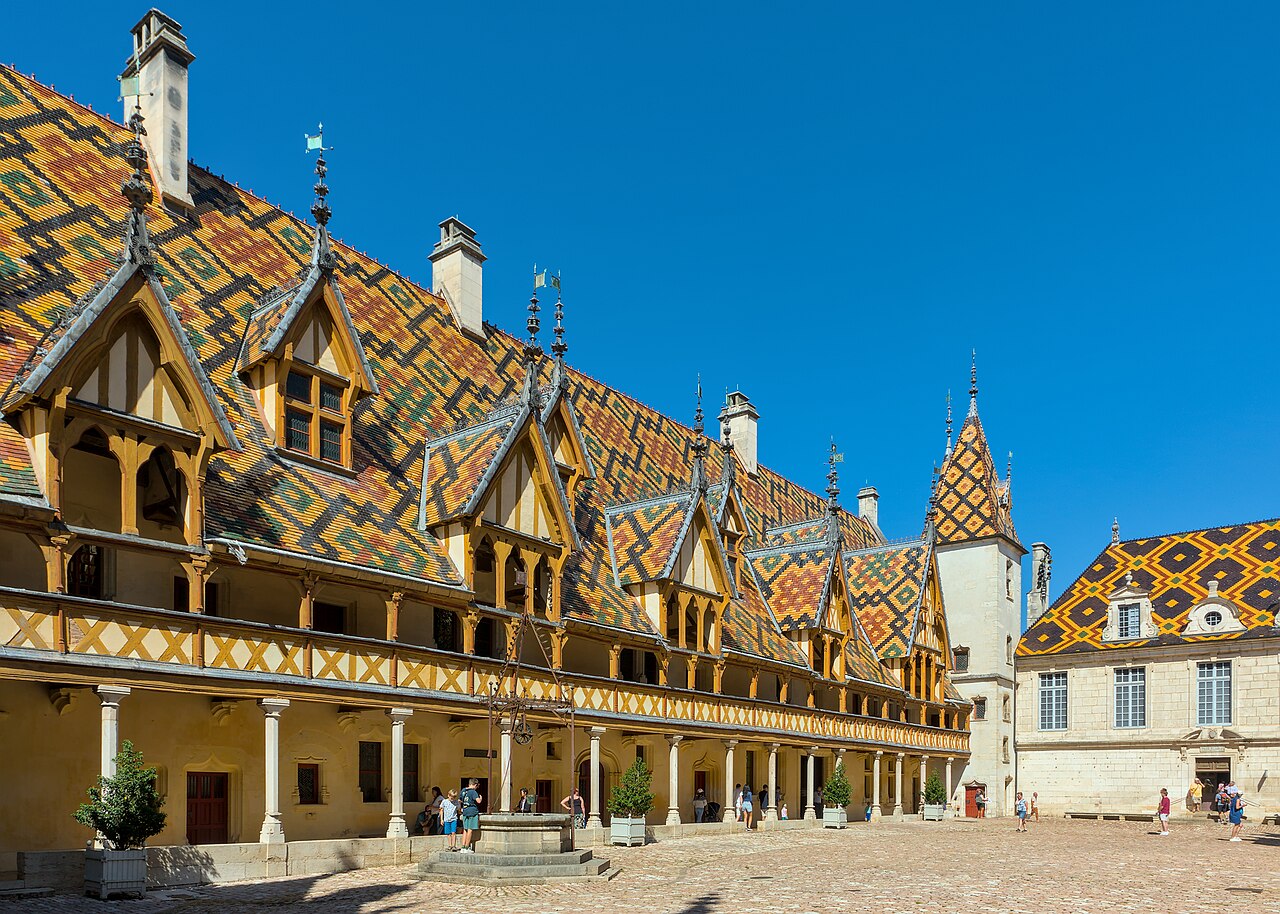
Beaune is at its heart. The town boasts the Hôtel-Dieu and its Hospices, a Gothic masterpiece with glazed tile roofs, historic wine cellars open to the public, and an old town center easily explored on foot. It's also the most convenient base for a group: coach drop-off points are clearly marked, and partner wineries are just a short drive away.
Along this central axis, several stops are worth including depending on the length of your stay: Dijon and its Palace of the Dukes of Burgundy, the Château du Clos de Vougeot nestled within its historic walled garden, the medieval town of Semur-en-Auxois, the UNESCO-listed Fontenay Abbey, or even Chablis further north for groups interested in mineral white wines. A full day allows for two vineyard visits and one cultural outing, but no more if you want to avoid rushing.
From Paris or from Lyon: planning your journeys
Burgundy is about a three-hour drive from Paris and less than two hours from Lyon. For an international group based in the capital, two formats work well. The first is a two-day stay with an overnight stay, which allows for a full day in the vineyards without turning the program into a road trip marathon. The second is a transfer to Burgundy integrated into a larger tour, for example, towards Provence or Alsace.
A day trip from Paris is still possible but demanding: six hours of driving in total leaves little room for sightseeing. Organizers looking for a day trip from Paris will find more suitable options in the Champagne region, a wine-growing area much closer. Our guide dedicated to Champagne, Reims and Épernay by bus with driver details this alternative for groups with limited time.
For small groups of eight to twenty people, a smaller vehicle is often preferable in the narrow streets of wine villages. Access to vineyard courtyards is sometimes limited, and the provision of a minibus with driver facilitates parking as close as possible to the cellars.
Things to consider before booking
Several factors determine the success of a Burgundy program and must be communicated as soon as the transport request is made.
- The exact number of participants and the volume of luggage determine the vehicle's capacity.
- Visit times for the estates are booked in advance and rarely flexible in high season.
- The period: the grape harvest, from the end of August to the end of September, saturates the roads and accommodation, and some estates then suspend visits.
- The working language of the group, to provide support adapted to non-French-speaking participants.
- Planned purchases in the cellar, which occupy a real volume in the hold on a circuit of several days.
- The driver's regulated driving times, which frame the length of the day and must be integrated into the program from its design stage.
Frequently Asked Questions
How many days should I allow to explore the vineyards of Burgundy? Two days is the minimum comfortable amount of time needed when departing from Paris: a day exploring the area and a night in the region avoid spending most of your time on the road. Three days allows you to add Chablis or the southern part of the Côte Chalonnaise without rushing.
Does the driver stay with the group during the estate visits? Yes. The vehicle and driver remain at your disposal throughout the agreed program. The group does not need to worry about connections or returning to a fixed starting point, and the itinerary can be adjusted during the day while respecting regulatory driving times.
What is the best time of year for this type of trip? From May to October, conditions are most favorable and vineyards are most available. The harvest season offers a unique atmosphere but makes bookings more difficult. Winter remains a viable option for groups focused on the wineries and urban heritage of Beaune and Dijon.
Plan your Burgundy tour
Burgundy rewards groups who take the time to explore it properly. An itinerary built around Beaune, two or three well-chosen stops, and a vehicle that follows the group everywhere are enough to transform a simple visit to wineries into a trip that participants will remember. The key lies in the planning, in ensuring coherence between the cultural program, the visits to the vineyards, and the actual constraints of the journey.
Our teams assist destination management companies, tour operators, and international organizers in creating these itineraries, in both French and English. Please send us your dates, group size, and desired itineraries by requesting your personalized quote : we will offer you the vehicle and schedule best suited to your group.


 French
  English
  Spanish
  Chinese
About The Author: Uniweb
More posts by uniweb