
Bordeaux is among the most sought-after French destinations for international groups, and for a simple reason: the city combines, within a few kilometers, a historic center listed as a UNESCO World Heritage Site, one of the world's most prestigious wine regions, and direct access to the Atlantic Ocean. For a foreign tour operator, the challenge isn't finding things to see, but rather connecting sites scattered across a large area without wasting half the trip on transfers.
This is precisely the role of a private coach with a driver. The châteaux of the Médoc, the hillsides of Saint-Émilion, and the Arcachon Basin are not conveniently served by public transport, and a group of thirty to sixty people cannot be dispersed among individual vehicles. This guide details everything you need to know to organize a coherent Bordeaux tour, from choosing the route to the practical constraints of parking in the wine villages.
Why Bordeaux is best explored by private coach
The Bordeaux region is laid out in a star shape around the city. Saint-Émilion lies about forty kilometers to the east, the great Médoc vineyards stretch northwest along the estuary, Sauternes extends to the south, and the Arcachon Basin closes the horizon to the west, some sixty kilometers away. Each direction represents at least half a day's itinerary, and none can easily be combined with another in the same morning.
A vehicle dedicated to the group transforms the nature of the trip: the coach waits during the tasting, transports the cases purchased at the estate, and allows for a fifteen-minute delay to departure without causing anyone to miss a connection. For organizers unfamiliar with the French system, our service of coach hire with driver covers all of these journeys, including long-distance connections from Paris, which is approximately 580 kilometers away.
A day in the historic center
The heart of Bordeaux is best explored on foot: the protected area is compact, and much of the quayside and shopping streets are pedestrianized or have restricted traffic. The coach's role is therefore to drop the group off at the right place in the morning and pick them up at the end of the tour, without requiring long walks between points of interest.
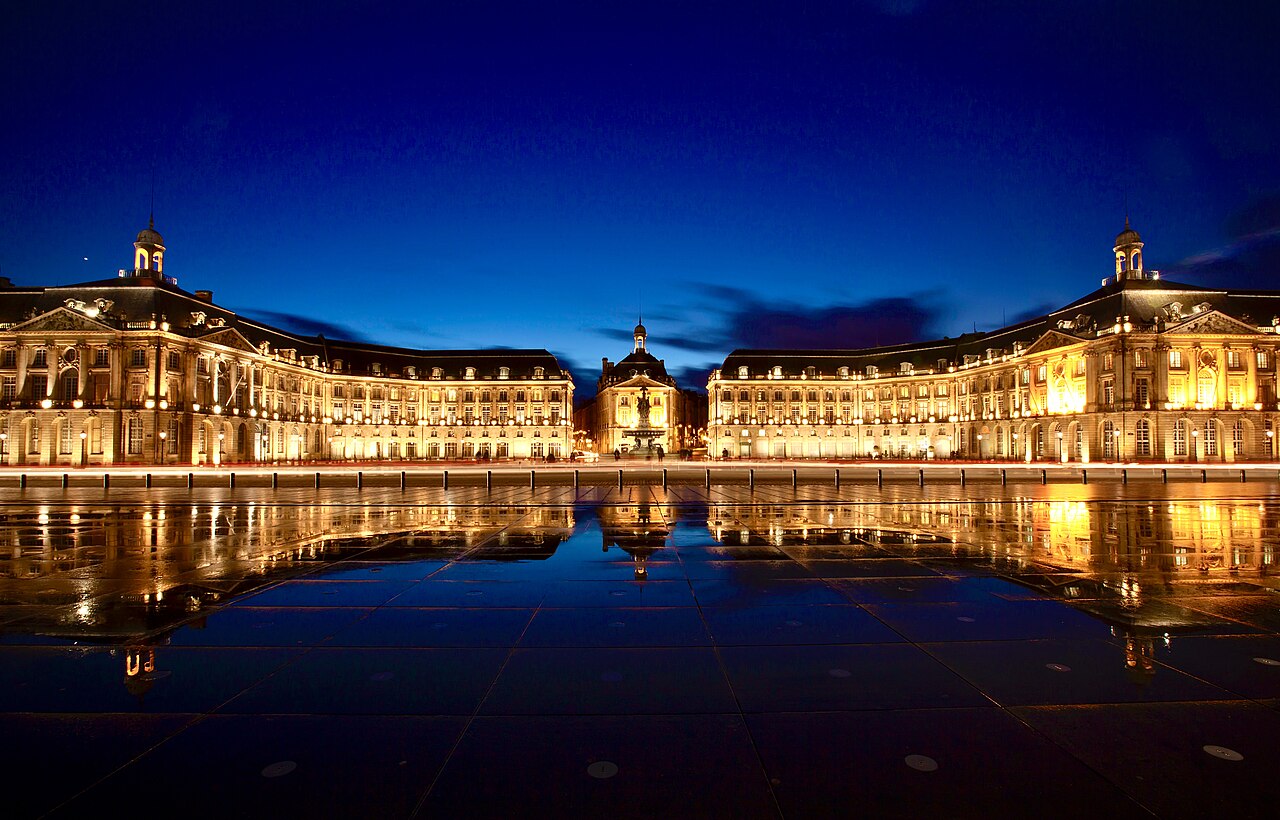
- The Place de la Bourse and its reflecting pool, the easiest meeting point to identify for an international group.
- Saint Andrew's Cathedral and the Pey-Berland Tower are just a few minutes' walk away.
- The Grand Theatre and the classic streets of the golden triangle.
- The Cité du Vin, north of the city, requires a bus transfer from the centre.
- The refurbished quays are perfect for a free end to the day before returning to the hotel.
Plan to communicate the drop-off and pick-up points to your carrier in advance: in a dense city centre, a clear meeting point marked on a map avoids cascading delays for the rest of the day.
The three vineyards to be decided
A group rarely has the time to cover all the appellations. The choice is generally made between three directions, each with a very different identity.
- Saint-Émilion The listed medieval village, its monolithic church and its human-scale properties. This is the most visually appealing and shortest option, therefore the most suitable for a half-day.
- The Médoc The Château Route, from Margaux to Pauillac, features world-renowned estates. The distances are longer, and the linear route is well-suited to a coach that follows the group from estate to estate.
- Sauternes and Graves : sweet wines and a more rural landscape, often chosen by groups returning to the region for a second time.
Organizers who are building a larger wine tour in France frequently combine this Bordeaux stop with a second wine region. Our article dedicated to Burgundy vineyards by private coach details the logic of the great wine route, which is very different from the Bordeaux model.
Practical constraints to anticipate
Three points consistently recur in wine-related circuits and deserve to be addressed from the preparation phase.
First, there's the issue of access to the villages. The old wine-growing towns weren't designed for twelve-meter vehicles. Coaches park in designated areas on the outskirts, and the group finishes the tour on foot. This detail affects the actual duration of the visit: walking time must be factored into the itinerary.
Next, there are regulations concerning driving time. Drivers are subject to strict European rules regarding driving and rest periods. A day that includes an early morning transfer, three castles, and a late return must be confirmed in advance with the transport company, otherwise the last visit may have to be shortened.
Finally, the tasting itself. No one drives, which is one of the most compelling reasons to opt for a private coach in a wine region. However, be sure to bring water on board and storage space for any bottles purchased locally.
Large coach or minibus depending on the size of the group
The vehicle's size significantly impacts the quality of a wine tour. A coach with fifty to sixty seats remains the most economical and comfortable solution for a full group following a shared itinerary. However, for a smaller group, a professional delegation, or a group of fewer than twenty people wishing to access more secluded estates, the minibus hire with driver offers superior flexibility on the narrow vineyard roads.
Some tours combine both formats: a large coach for long transfers and city days, and minibuses for the tasting day in smaller appellations. This option should be priced from the initial request, as it changes the drivers' schedules.
Frequently Asked Questions
How much time should you allow to visit Bordeaux and its vineyards in a group? Two full days is the most common format: the first day dedicated to the historic center of Bordeaux and the second to a wine region, such as Saint-Émilion, the Médoc, or Sauternes. A three-day trip allows you to add the Arcachon Basin and the Dune du Pilat without excessively lengthening travel time.
Can a coach park directly in wine-growing villages? Villages classified as Saint-Émilion have designated drop-off zones and parking areas for coaches located on the outskirts of the village, as the steep, cobbled streets of the center are unsuitable for longer vehicles. The group disembarks at the nearest drop-off point and then walks to the center, where the driver picks up the group at the agreed-upon meeting point.
Do we need to book castle visits in advance for a group? Yes, almost all wineries only accept groups by reservation, with a maximum number of participants and specific times. It is advisable to reserve time slots before finalizing the itinerary, and then communicate these times to the transport company so that the driver's travel time and mandatory breaks can be calculated accordingly.
Plan your Bordeaux tour
Bordeaux rewards groups who are willing to make choices. A city, a vineyard, perhaps the ocean: a focused itinerary, served by a dedicated vehicle and a driver familiar with the routes, is far better than a series of stops separated by hours of driving. The quality of a wine tour is measured by the actual time spent at each site, not by the number of appellations visited.
For a group already based in the Gironde region, day trips can also depart directly from Bordeaux with our TDS agency Bordeaux, who knows the access points to properties in the Médoc and Saint-Émilion.
Our team assists international organizers in planning these itineraries, from airport or train station transfers to the final tasting. Send us your dates, number of participants, and planned stops via our quote request form : we will respond with a detailed proposal and a realistic itinerary in terms of travel time.

 French
  English
  Spanish
  Chinese
About The Author: Uniweb
More posts by uniweb